
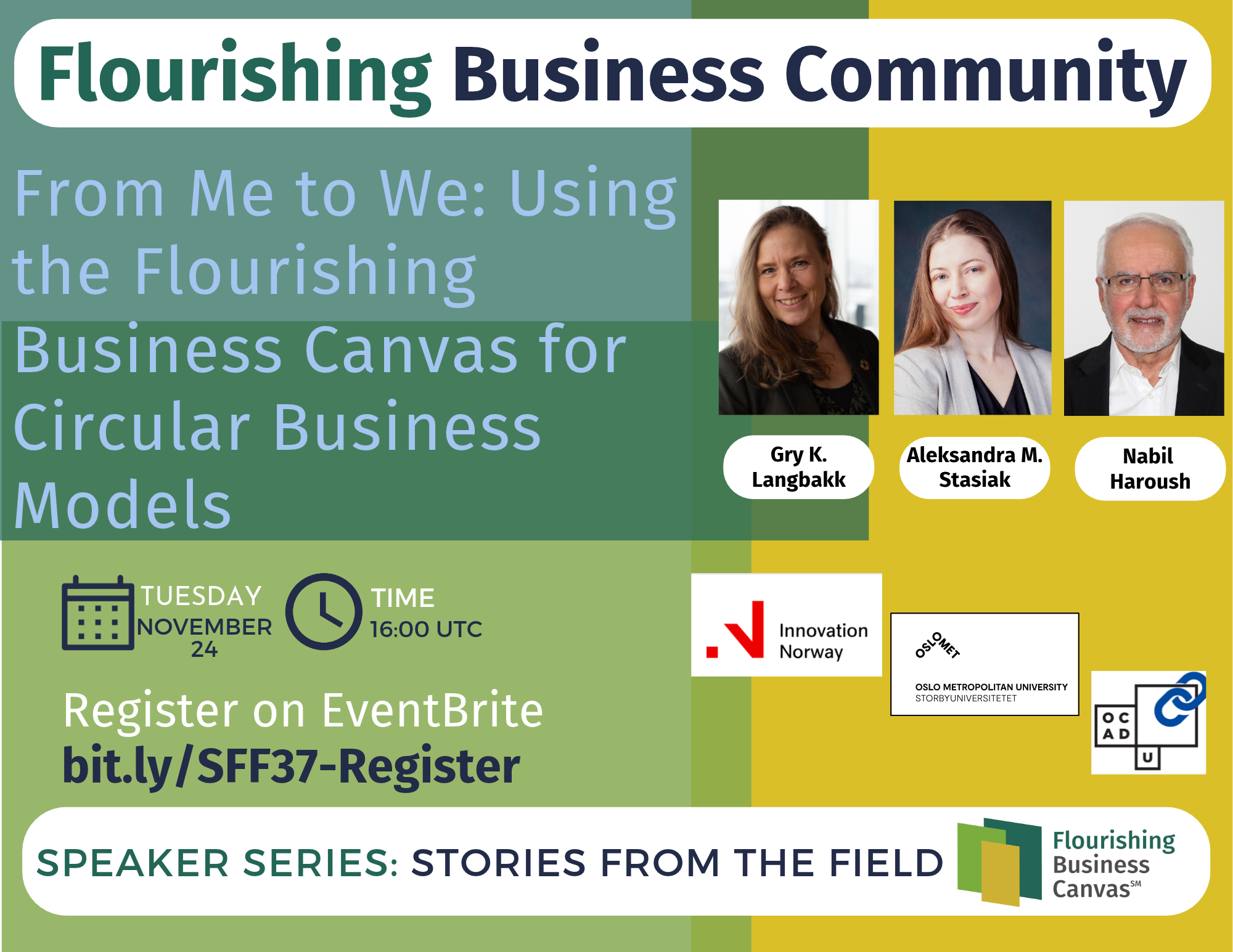
Flourishing Business Community Speakers Series: Stories from the Field #37
From Me to We: Using the Flourishing Business Canvas for Circular Business Models with Gry Langbackk and Aleksandra Stasiak, Introduced by Dr. Nabil Harfosh
| Date: Tuesday, November 24, 2026 |
| Time: 16h00 UTC – 08h00 PST, 11h00 EST, 13h00 BRT, 16h00 BST, 17h00 CET, 01h00 + 1 day JST. To convert UTC to your timezone, click here |
| Duration: 1 hour |
| Registration: Required via Eventbrite at bit.ly/SFF37-Register |
For our thirty-seventh monthly Flourishing Business Community Speaker Series entitled “Stories From the Field”, we are delighted to welcome Gry K. Langbakk from the national innovation agency of Norway, Innovation Norway, and Aleksandra M. Stasiak a Phd Candidate from Oslo Metropolitan University, Norway. Their work will be introduced by Dr. Nabil Harfoush from the Resilience Design Lab at the Ontario College of Art and Design University (OCADU), Toronto, Canada.
The Flourishing Enterprise Co-lab is grateful for the extensive support of our partner, Social Innovation at Georgian College, Ontario, Canada, to enable our community’s speaker series.
Our talk this month follows-on from the Flourishing Business Community’s powerful explorations at our September 8th speaker series around the future of Strongly Sustainable, aka, Flourishing, Circular Economy business model design (for more see here). So this month we are delighted to have speakers from Innovation Norway and Oslo Metropolitan University to share their experiences using the Flourishing Business Canvas (FBC) to assist consortia of Norwegian organizations establish multi-stakeholder value co-creation circular business models.
Gry Langbakk is a Special Advisor at Innovation Norway, working with green transition, circular economy and collaborative innovation. She coordinates the Green Platform programme on behalf of Innovation Norway, supporting ambitious collaborative projects involving companies, research institutions and other partners. Her work focuses particularly on how companies and value chains can combine sustainability with business development, innovation and long-term competitiveness.
Innovation Norway is the Norwegian Government’s main instrument for supporting business development, innovation and sustainable growth. Innovation Norway supports Norwegian companies through financing, advisory services, competence, networks and internationalisation. A key part of their role is helping companies and collaborative projects turn innovation into sustainable value creation and scalable business opportunities. Innovation Norway has been using the FBC extensively in their work since 2019 (see their testimonial here).
Aleksandra Stasiak is a PhD candidate in Innovation for Sustainability at Oslo Metropolitan University (OsloMet), working with systemic design and circular economy for plastics equipment in the fish farming industry, specifically the SirkAq consortia. She focuses on multi-perspective approaches to sustainable transitions, with particular interest in how stakeholders communicate and collaborate within circular ecosystems.
OsloMet is a major public university in Norway known for its professionally oriented programs in fields like health sciences, education, design, technology, and social sciences.
Dr Nabil Harfoush is a full professor in the OCADU Strategic Foresight & Innovation graduate program. He is also Director of the Resilience Design Lab. Nabil convened the Strongly Sustainable Business Model Group (SSBMG) at the OCADU Strategic Innovation Lab (sLab) in 2012. The SSBMG incubated the FBC and this community for many years***. Nabil has introduced the FBC into graduate programs at multiple universities including OCADU, JeffersonU, and HarvardU.
OCAD University is the largest art and design school in Canada, celebrating its 150th anniversary this year. It has expanded design to new domains such as strategy design, systemic design, business model design, and resilience design.
Gry writes: “In my work with circular economy innovation consortia, one of the most important applications of the FBC is to help the partners develop a shared business model for the consortium. For circular business models, I also use three interconnected flows as a simple way of structuring the discussion: materials, information and money. A circular material flow will not be sustainable unless the necessary information moves between the actors and there is also a viable financial flow. Mapping these three flows alongside the FBC helps the consortium identify dependencies between partners, understand where value is created and captured, and explore what each actor needs in order for the overall circular business model to work.”
Aleksandra writes: “Circular economy and value co-creation have a lot in common both requiring stronger stakeholder connection. So in my work I wondered if business models can be used as joint exercise and if value can be co-created in a practical context. This led me to use the FBC to help describe circular economy value co-creation within a multi-stakeholder consortium. In my field research I facilitated co-design workshops to explore how circular strategies are connected across the value chain.”
In their presentation, Gry and Aleksandra will be reporting on a use case never imagined for the FBC – modelling an entire “circle” of collaborating businesses on a single canvas. Further, while this use case was considered and possible for the Strongly Sustainable Business Model Ontology, the technical artifact that “powers” the FBC, it has never been previously applied in this way. (To learn more about the SSBMO see “Summary of Masters Research” on this page)
In their presentation Gry and Aleksandra will share:
- The context for the circular economy consortia programme of the Government of Norway, and the role of Innovation Norway within that programme
- Innovation Norway’s objective for using the Canvas with Circular Economy consortia
- The research question in Aleksandra’s PhD, and the methodological approach she took
- The reaction of companies within the consortia when they participated in workshops to map the business model of the entire circle using a single FBC
- Lessons learned:
- What the FBC does well in this unanticipated use case?
- What future tools and methods need to do to provide even more useful support to circular economy business model design?
- Key takeaways, research limitations, and recommendations for strengthening.
- Their hope is that the Flourishing Business Community will build on their work and create new tools and methods to apply flourishing business model design principles to enable strongly sustainable circles to be co-created, validated and realized in practice.
At the end of their talk Gry and Aleksandra will take questions from members of the community.
After the event, a video of the talk plus slides will be shared in the “Speaker Series” space of the Flourishing Business Community. Please join other Flourishing Business leaders and become a full member to access.
*** The Strongly Sustainable Business Model Group (SSBMG) at the OCADU Strategic Innovation Lab (sLab) was convened in 2012. For many years the SSBMG incubated the Flourishing Business Canvas, and the early days of what has become the world-wide Flourishing Business Community. As the Flourishing Enterprise Movement was convened by the SSBMG 2012-2019, In 2019 the SSBMG evolved to become the Flourishing Enterprise Institute and Community for Flourishing Enterprise (C4FE) whose mission is to explore all aspects of flourishing organizations. The Flourishing Enterprise Co-lab not-for-profit was established in 2021 to steward and convene this world-wide Flourishing Business Community. Our members are specifically focused on the application and further development of the Canvas and the other components of the Flourishing Enterprise Innovation Toolkit.